
-
Daniel Carter
- 15 Mins Read

Apple’s current Apple Watch lineup covers three very different buyers: the do-it-all Series 11, the budget-friendly SE 3, and the rugged, satellite-connected Ultra 3. All three shipped in September 2025 and are still Apple’s active models heading into the September 2026 refresh. This guide breaks down exactly what each model offers, how they compare on paper, which older models are still worth buying, and how Apple’s ongoing legal fight with Masimo has affected the Blood Oxygen app in the United States.
A quick note on how this guide was put together: we don’t always have every Apple Watch model in hand for physical testing, particularly for things like real-world GPS accuracy. Where that’s the case, we’ve relied on Apple’s official specifications and cross-referenced hands-on impressions from outlets that have tested the devices directly, such as Tom’s Guide, 9to5Mac, CNN Underscored, and MacRumors. We’ve flagged manufacturer claims as such throughout.
- Check out our Best Fitness Trackers in 2026
Quick Answer: Our Top Apple Watch Picks for 2026
If you only read one section, read this one. Here’s how the current Apple Watch lineup breaks down by buyer type.
Best Overall — Apple Watch Series 11
The Series 11 is Apple’s mainstream pick for most people. It starts at $399 for the 42mm GPS model, and for the first time the standard Series line gets a genuine battery life bump — up to 24 hours per charge, along with 5G cellular support, tougher Ion-X glass, and new hypertension notifications and sleep score features. It’s the model to buy if you want the complete Apple Watch health and fitness experience without stepping up to Ultra pricing.
Best Budget — Apple Watch SE 3
The SE 3 starts at $249 for the 40mm GPS model and is the best value in the lineup. It runs the same S10 chip as the Series 11 and Ultra 3, adds an Always-On display and fast charging for the first time in the SE family, and gains sleep apnea notifications and wrist temperature sensing. It skips the ECG app, Blood Oxygen app, and hypertension notifications, but for most first-time buyers or people upgrading from an older SE, it covers the vast majority of what makes an Apple Watch useful.
Best for Adventure & Battery Life — Apple Watch Ultra 3
The Ultra 3 starts at $799 and is built for people who spend real time outdoors. It’s the first Apple Watch with built-in satellite communications, letting you text emergency services, share your location, and message contacts even without cellular or Wi-Fi coverage. Battery life climbs to up to 42 hours of normal use (72 hours in Low Power Mode), and it pairs that with the largest, brightest display Apple has put on a watch and a titanium case rated to MIL-STD-810H durability standards.
Apple's Current Apple Watch Lineup Explained
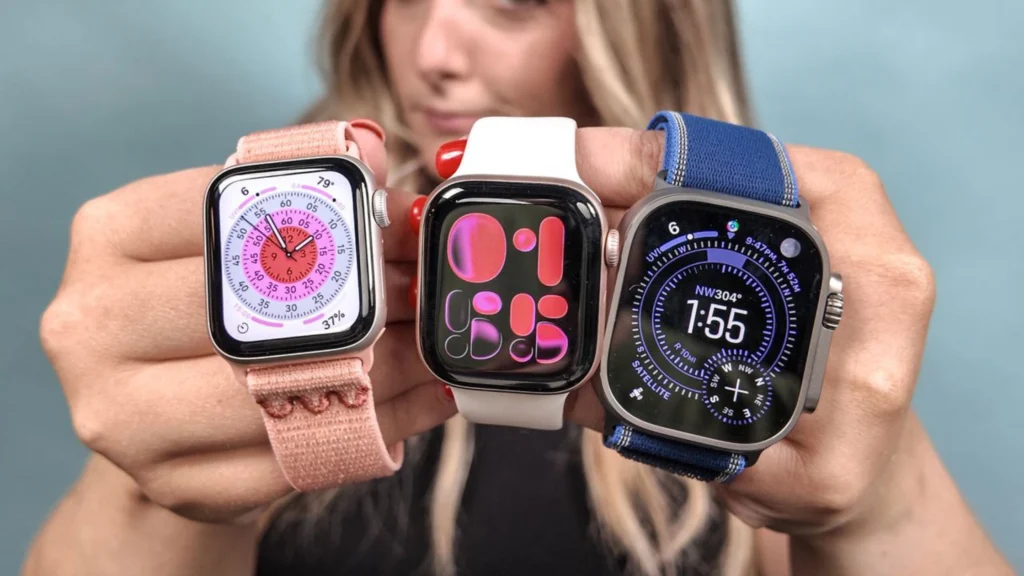
Apple sells three Apple Watch families side by side, and understanding the tiering makes the rest of this guide easier to follow.
- Apple Watch SE 3 — the entry-level model, aluminum only, 40mm/44mm, starting at $249. Built for people who want core Apple Watch functionality (fitness tracking, notifications, Apple Pay, Siri) without paying for advanced sensors.
- Apple Watch Series 11 — the mainstream flagship, available in aluminum or titanium, 42mm/46mm, starting at $399. This is Apple’s most full-featured everyday watch, with the complete health sensor suite.
- Apple Watch Ultra 3 — the rugged, adventure-focused flagship, titanium only, one 49mm size, starting at $799. Built around battery life, durability, and off-grid safety features like satellite SOS.
All three models launched together on September 9, 2025, and became available on September 19, 2025, alongside the iPhone 17 lineup. All three run watchOS 26 out of the box and are eligible for the watchOS 27 update expected in September 2026. Apple is widely expected to refresh the lineup with a Series 12 and possibly an Ultra 4 in September 2026, which we cover near the end of this guide.
Apple Watch Series 11

The Apple Watch Series 11 is Apple’s mid-range, mainstream smartwatch, and for 2025 it focused on two things that Apple Watch owners have wanted for years: better battery life and better cellular performance, while adding meaningful new health features on top of an already comprehensive sensor suite.
Key Specs & Features
| Case Sizes | 42mm, 46mm |
| Case Materials | Aluminum or Titanium |
| Chip | S10 SiP |
| Display | LTPO OLED, Always-On, up to 2,000 nits, Ion-X glass (2× more scratch-resistant than Series 10) |
| Battery Life | Up to 24 hours of normal use; up to 38 hours in Low Power Mode |
| Fast Charging | Up to 8 hours of use from a 15-minute charge |
| Connectivity | GPS or GPS + Cellular with 5G support |
| Water/Dust Resistance | WR50 (50 meters); IP6X dust resistance |
| Storage | 64GB |
| Starting Price | $399 (42mm GPS); $429 (46mm GPS); +$100 for Cellular |
| Release Date | September 19, 2025 |
Health & Fitness Tracking (Hypertension Notifications, Sleep Score, 5G)
The headline health feature on Series 11 is hypertension notifications, a new tool that analyzes optical heart sensor data over roughly 30 days looking for patterns consistent with chronic high blood pressure. If it detects a consistent pattern, it prompts the wearer to log blood pressure readings for seven days using a manual blood pressure cuff and share the results with a doctor. The feature received FDA 510(k) clearance in September 2025 and is designed to work on Series 9 and later, as well as Ultra 2 and later — so it isn’t exclusive to the Series 11, but the Series 11 ships with it enabled out of the box.
Series 11 also introduces sleep score, a watchOS 26 feature that gives wearers a nightly score summarizing sleep quality, drawing on guidance from the American Academy of Sleep Medicine, the National Sleep Foundation, and the World Sleep Society. Apple says the underlying algorithm was built using more than five million nights of sleep data collected through the Apple Heart and Movement Study.
On the connectivity side, Series 11 is the first standard Apple Watch to support 5G cellular, alongside a redesigned antenna system that can use two antennas simultaneously in weak-signal areas to improve reception. The rest of the health sensor suite carries over from recent generations: the ECG app (FDA-cleared since 2018 for detecting signs of atrial fibrillation), irregular rhythm notifications, the Blood Oxygen app (subject to the ongoing Masimo dispute discussed later in this guide), sleep apnea notifications (FDA-cleared in September 2024), and Cycle Tracking with retrospective ovulation estimates powered by the wrist temperature sensor.
Battery Life & Durability
Series 11’s 24-hour battery rating is a genuine step up — the Series 10 and every standard Apple Watch before it were rated for 18 hours. Apple achieved this by fitting a larger battery into the same case dimensions as the Series 10 rather than through a major chip redesign; the Series 11 actually reuses the same S10 chip found in the Series 10 and Ultra 3. Reviewers at 9to5Mac who tested Series 11 alongside its predecessor described the gain as meaningful enough that users could realistically track a full night’s sleep without running the battery dry the following day.
On durability, Apple’s aluminum Series 11 models use a new Ion-X glass that the company says is roughly twice as scratch-resistant as the Series 10’s cover glass, treated with a ceramic coating for added surface hardness. Titanium models retain a sapphire crystal front. Water resistance is rated to 50 meters (WR50), and the case carries an IP6X dust-resistance rating, matching recent generations.
Who Should Buy the Series 11
The Series 11 makes the most sense for anyone upgrading from a Series 9 or older model, since it combines better battery life with 5G and the two new health features. It’s also the right call for SE owners who want ECG, Blood Oxygen, and hypertension tracking. If you already own a Series 10, the case for upgrading is thinner — you’re mainly paying for the battery bump, 5G, and tougher glass, since the chip and core design haven’t changed.
Apple Watch SE 3
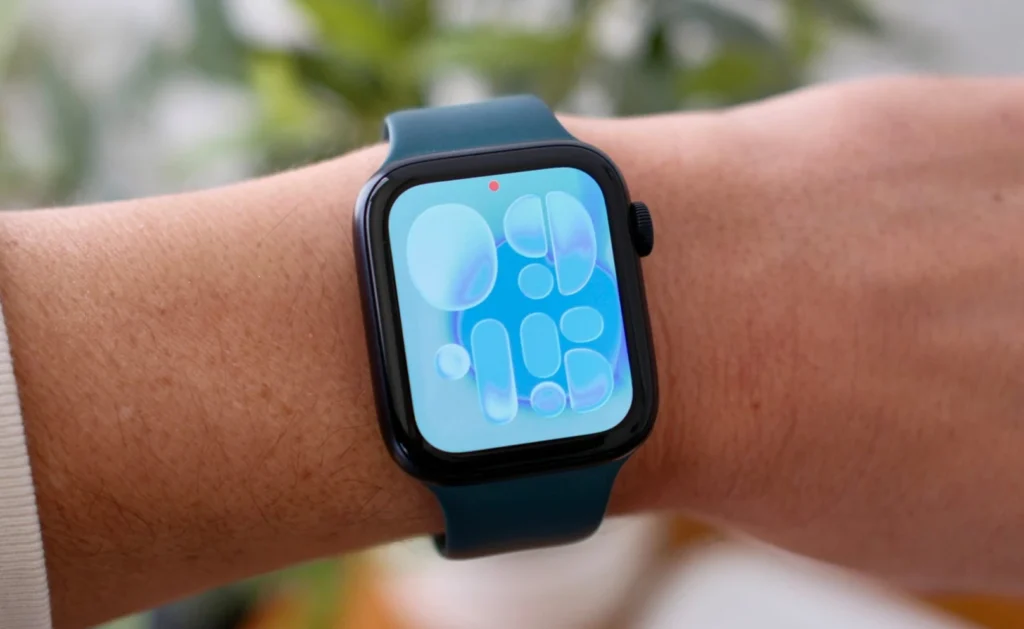
The third-generation Apple Watch SE got the biggest single upgrade of any model in the September 2025 refresh relative to its predecessor, closing much of the gap with the Series 11 while holding its price steady.
Key Specs & Features
| Case Sizes | 40mm, 44mm |
| Case Material | Aluminum only |
| Chip | S10 SiP |
| Display | Always-On Retina OLED, up to 1,000 nits |
| Battery Life | Up to 18 hours normal use; up to 32 hours in Low Power Mode |
| Fast Charging | Yes — new for the SE line; roughly 0–80% in 45 minutes |
| Connectivity | GPS or GPS + Cellular (LTE) |
| Water Resistance | WR50 (50 meters) |
| Storage | 64GB |
| Starting Price | $249 (40mm GPS); Cellular models cost extra |
| Release Date | September 19, 2025 |
What’s Missing Compared to Series 11 (No ECG, No Blood Oxygen)
The SE 3’s biggest limitations are concentrated in a small set of health features. It has no ECG app, no Blood Oxygen app, and no hypertension notifications, because those features rely on the third-generation optical heart sensor and the electrical heart sensor, neither of which Apple includes on the SE. Instead, the SE 3 uses a second-generation optical heart sensor that still supports high and low heart rate alerts, irregular rhythm notifications, and low cardio fitness notifications, but not the more advanced diagnostics. It also lacks an Ultra Wideband chip (so no Precision Finding for a paired iPhone) and isn’t certified IP6X for dust resistance, and its Wi-Fi radio is limited to 2.4GHz.
What the SE 3 does keep is notable: it runs the same S10 chip as the Series 11 and Ultra 3, so on-device Siri, the Double Tap and Wrist Flick gestures, and the Always-On display all behave identically to the pricier models. It’s also the first SE with sleep apnea notifications, wrist temperature sensing for cycle tracking, sleep score, and 5G cellular support — features that were exclusive to the Series line as recently as 2024.
Who Should Buy the SE 3
The SE 3 is the best pick for first-time Apple Watch buyers, anyone upgrading from the original SE or SE 2, and parents setting up a watch for a child through Family Setup. It’s also a sensible choice for anyone who doesn’t have a specific need for ECG or Blood Oxygen readings — CNN Underscored’s review noted that most SE 3 testers didn’t miss those features in day-to-day use. If continuous blood oxygen monitoring, ECG, or hypertension tracking matter to you, step up to the Series 11 instead.
Apple Watch Ultra 3
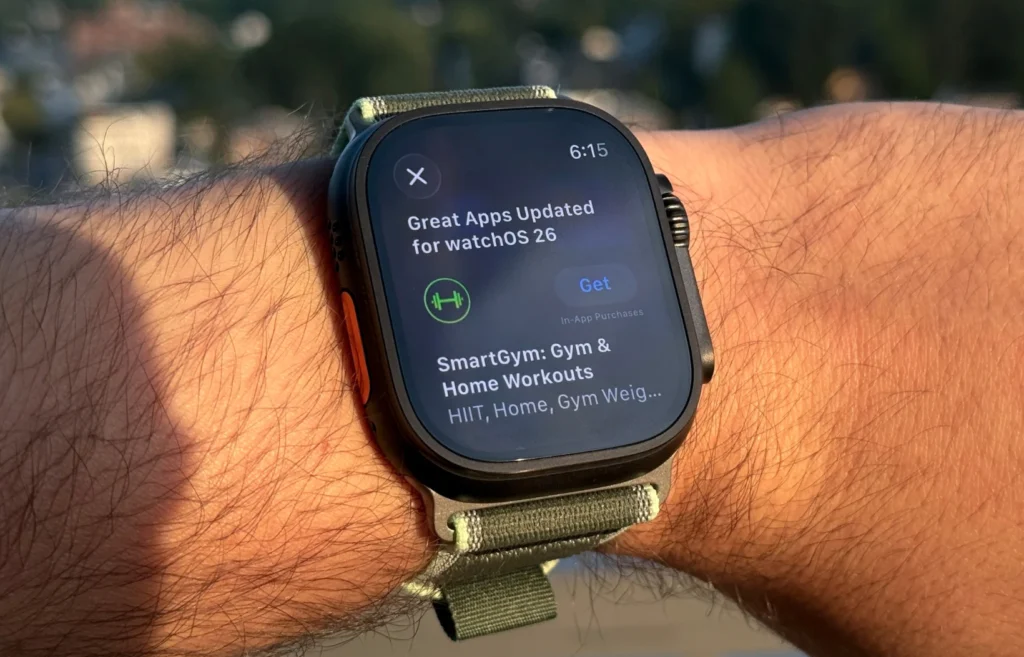
The Apple Watch Ultra 3 is Apple’s most capable smartwatch, aimed at outdoor athletes, endurance racers, and anyone who wants the longest battery life and the toughest build Apple offers. It’s priced at a flat $799 regardless of band choice, and 2025’s update was a bigger jump than the largely cosmetic Ultra 2 refresh that came before it.
Key Specs & Features
| Case Size | 49mm (one size only) |
| Case Material | Aerospace-grade Titanium (Natural or Black) |
| Chip | S10 SiP |
| Display | LTPO3 OLED, Always-On at up to 1Hz refresh, up to 3,000 nits, Sapphire Crystal Front |
| Battery Life | Up to 42 hours normal use; up to 72 hours in Low Power Mode; up to 20 hours of outdoor workout tracking with full GPS/HR |
| Fast Charging | Up to 12 hours of use from a 15-minute charge |
| Connectivity | 5G Cellular + Built-in Satellite Communications |
| Water Resistance | WR100 (100 meters); EN13319 rated for recreational diving to 40m |
| Durability | MIL-STD-810H Certified |
| Storage | 64GB |
| Starting Price | $799 |
| Release Date | September 19, 2025 |
Satellite Communications & Extended Battery Life
Ultra 3 is the first Apple Watch with built-in, two-way satellite communications, a feature Apple first brought to iPhone with the iPhone 14 in 2022. When you’re outside cellular and Wi-Fi range, Ultra 3 lets you send an Emergency SOS, exchange text messages with contacts, and share your location via Find My, all directly from the watch. If Ultra 3 detects a hard fall or a severe car crash and you’re unresponsive, it can automatically attempt to reach emergency services over satellite. Apple is offering the satellite feature free for two years from the date of purchase; pricing after that point hasn’t been announced. Emergency SOS via satellite requires an active connection to a satellite in view of open sky, and Messages and Find My via satellite additionally require an active cellular plan.
Battery life is the Ultra 3’s other headline upgrade, climbing from the Ultra 2’s 36-hour rating to 42 hours of normal use, and up to 72 hours in Low Power Mode. Tom’s Guide’s review attributed the gain to the combination of the more efficient LTPO3 display, a redesigned 5G modem, and a larger battery cell. For continuous outdoor workout tracking with full GPS and heart-rate sampling, Apple rates the Ultra 3 for 20 hours in Low Power Mode, up from prior generations.
Who Should Buy the Ultra 3
The Ultra 3 is built for people who spend meaningful time away from cell coverage — trail runners, backcountry skiers, hikers, sailors, and divers — and for anyone who simply wants the longest possible battery life and largest display Apple offers. At $799, it’s a significant jump over the Series 11, and its 49mm titanium case is noticeably larger and heavier on the wrist, so it’s not the best fit for smaller wrists or people who just want a slimmer everyday watch. For most non-outdoor use cases, the Series 11 delivers nearly the same health tracking and smart features at a lower price and in a smaller package.
Apple Watch Series 11 vs. SE 3 vs. Ultra 3: Full Comparison
| Feature | Series 11 | SE 3 | Ultra 3 |
|---|---|---|---|
| Starting Price | $399 | $249 | $799 |
| Case Sizes | 42mm / 46mm | 40mm / 44mm | 49mm only |
| Case Material | Aluminum or Titanium | Aluminum only | Titanium only |
| Chip | S10 | S10 | S10 |
| Battery (Normal Use) | Up to 24 hrs | Up to 18 hrs | Up to 42 hrs |
| 5G Cellular | Yes (optional) | Yes (optional) | Yes (included) |
| Satellite Communications | No | No | Yes |
| ECG App | Yes | No | Yes |
| Blood Oxygen App | Yes* | No | Yes* |
| Hypertension Notifications | Yes | No | Yes |
| Sleep Score | Yes | Yes | Yes |
| Sleep Apnea Notifications | Yes | Yes | Yes |
| Always-On Display | Yes | Yes | Yes |
| Water Resistance | 50m | 50m | 100m |
| Max Brightness | 2,000 nits | 1,000 nits | 3,000 nits |
Blood Oxygen readings are available on US models again after Apple’s redesigned, iPhone-processed version of the feature cleared U.S. Customs and the ITC — see the Masimo dispute section below for the full timeline.
The Previous Generation: Ultra 2, Series 10, and SE 2
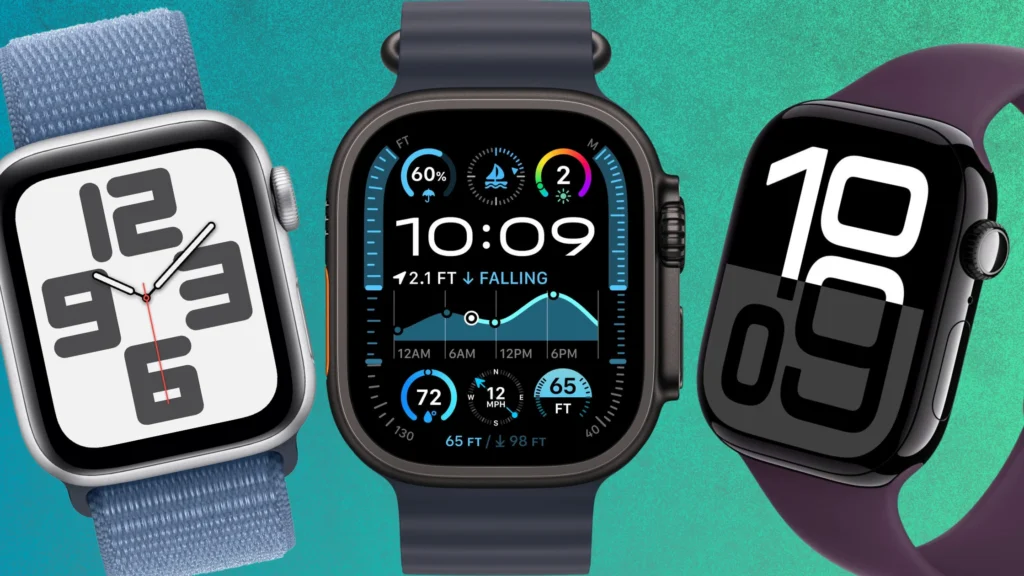
Apple doesn’t pull older Apple Watch models from sale the moment a new generation launches, and previous-generation models routinely show up at a discount from Apple and third-party retailers. Here’s how the outgoing generation stacks up.
Apple Watch Ultra 2
The Apple Watch Ultra 2 launched in September 2023 at $799 and received a black titanium finish option in 2024, but its underlying hardware has stayed the same since launch. It uses the S9 chip, offers up to 36 hours of battery life (72 hours in Low Power Mode), and has the same 49mm titanium case, sapphire display, and MIL-STD-810H durability rating as the Ultra 3. It does not have 5G or satellite communications — those are Ultra 3 exclusives. It remains a capable, rugged watch, and Tom’s Guide has noted it can regularly go two to three days between charges even with sleep tracking enabled.
Apple Watch Series 10
The Apple Watch Series 10 launched in September 2024 for its 10th-anniversary redesign: a larger, nearly edge-to-edge display, a case that’s roughly 30% thinner than the Series 9, and the introduction of the S10 chip along with sleep apnea notifications. It starts at $399 (42mm) or $429 (46mm) and is rated for up to 18 hours of battery life — 6 hours less than the Series 11’s 24-hour rating, which is the single biggest difference between the two generations. It also lacks 5G and the Series 11’s tougher Ion-X glass, but otherwise runs the same core health sensor suite, including ECG, Blood Oxygen (subject to the same Masimo-related caveats), and ultimately gained hypertension notifications and sleep score through the watchOS 26 software update, since those features aren’t hardware-exclusive to Series 11.
Apple Watch SE 2
The second-generation Apple Watch SE launched in September 2022 and is now sold at a steep discount versus the SE 3 — commonly around $170 new or under $140 refurbished. It uses the older S8 chip, which is fast enough to run watchOS 26 and features like sleep score, the Vitals app, Training Load, and Crash Detection, but it does not support the SE 3’s Always-On display, fast charging, Double Tap, or Wrist Flick gestures, and it lacks sleep apnea notifications. Like all SE models, it has no ECG or Blood Oxygen sensor.
Is It Worth Buying a Previous-Gen Model in 2026?
For most buyers, yes — with caveats. The Ultra 2 is the easiest recommendation of the three: aside from 5G and satellite communications, it offers essentially the same experience as the Ultra 3 for a lower price whenever retailers discount it. The Series 10 is a reasonable buy if you can find it meaningfully cheaper than the Series 11 and don’t mind 6 fewer hours of battery life and no 5G. The SE 2 is harder to recommend now that the SE 3 exists at the same $249 starting price with a much longer feature list — the SE 2 mainly makes sense if you find one heavily discounted or refurbished and don’t need Always-On display or fast charging.
Upgrade Guide: Should You Upgrade From an Older Apple Watch?

Series 9 and Earlier
If you’re on a Series 9, Series 8, or older, the Series 11 is a clear upgrade: you’ll gain roughly a third more battery life, 5G cellular, hypertension notifications, sleep score, and (on Series 8 and earlier) a meaningfully brighter, larger display. Series 9 owners specifically already have hypertension notifications and sleep score via the watchOS 26 update, since Apple made those software features available back to Series 9 and Ultra 2, so the case for upgrading rests more on battery life and 5G than on health features alone.
Series 6, 7, and 8
These models miss out on the display redesign that arrived with the Series 10, the S9/S10 chip generation, and the newer health features tied to more recent chips. If your watch still works well and holds a charge, there’s no urgency to replace it, but if you’re already considering a new watch, the Series 11 will feel like a significant jump in screen size, speed, and battery life.
Original Apple Watch SE (2020)
The first-generation SE, modeled on the Apple Watch Series 5 design, is now several years past Apple’s active watchOS support window and is a strong candidate for replacement. The SE 3 offers a materially faster chip, a much better display, sleep apnea notifications, fast charging, and gesture controls the original SE never had, all while staying at a similar or lower entry price point.
Blood Oxygen Sensor on US Apple Watches: The Masimo Dispute, Explained

If you’ve noticed conflicting information online about whether the Apple Watch can measure blood oxygen in the United States, it’s because of a long-running patent dispute with medical device maker Masimo — one of the more convoluted storylines in recent Apple Watch history. Here’s the timeline in plain terms.
- 2020: Apple launches the Apple Watch Series 6 with a Blood Oxygen app. In 2021, Masimo files a complaint with the U.S. International Trade Commission (ITC) alleging the feature infringes its pulse-oximetry patents.
- December 2023: The ITC rules in Masimo’s favor and issues a limited exclusion order, effectively banning the import and sale of Apple Watch Series 9 and Ultra 2 models with Blood Oxygen enabled.
- January 2024: Apple disables the Blood Oxygen app in software on US units and resumes sales of the Series 9 and Ultra 2 without the feature.
- August 2025: Apple rolls out a redesigned version of the feature that shifts the blood oxygen calculation from the watch itself to the paired iPhone, and secures approval from U.S. Customs and Border Protection to import and sell watches with the reworked feature.
- Late 2025: Masimo challenges the redesign, both by suing Customs and by asking the ITC to rule that Apple’s workaround still violates the original exclusion order. Separately, a federal jury orders Apple to pay Masimo $634 million in a related patent case (Apple is appealing).
- March 18, 2026: An ITC Administrative Law Judge issues an Enforcement Initial Determination finding that Apple’s redesigned Blood Oxygen feature does not infringe Masimo’s patents.
- April 17-18, 2026: The full ITC Commission declines to review that determination, formally closing the case and confirming that Apple’s redesigned Blood Oxygen feature can remain on sale in the United States.
Separately, the U.S. Court of Appeals for the Federal Circuit affirmed the original 2023 ITC decision finding that the pre-redesign version of the Apple Watch did infringe Masimo’s patents — so the original exclusion order itself stands, but it doesn’t apply to Apple’s newer, iPhone-processed implementation. ITC decisions can still be appealed further, including potentially to the Supreme Court, so it’s not guaranteed to be the final word, but as of this writing the current Blood Oxygen implementation is legally cleared to sell in the US.
How the Blood Oxygen Workaround Works
Under the redesigned system, the Apple Watch’s optical sensor still collects the raw light-based data used to estimate blood oxygen saturation, but instead of calculating the SpO2 reading on the watch itself, that raw data is sent to a paired iPhone, where the calculation happens and the result is displayed in the Health app. The reading is not shown on the watch face itself. Apple has said this architectural change is what distinguishes the new version from the one found to infringe Masimo’s patents.
April 2026 ITC Ruling and What Changed
Practically speaking, the April 2026 ITC ruling means US buyers of the Series 11, SE 3 (which never had Blood Oxygen to begin with), and Ultra 3, as well as compatible older models, can access blood oxygen readings again through the iPhone-based workaround, and Apple can continue importing and selling watches with that feature without violating the exclusion order. It’s not clear whether Apple will extend on-watch SpO2 display to existing owners or keep the reading iPhone-only going forward, and further appeals from Masimo remain possible.
Apple Watch Health Features Compared Across Models

Because health sensors vary by model and by chip generation, it’s easy to get confused about which watch supports which feature. Here’s a model-by-model breakdown of the headline health tools.
Hypertension Notifications
Available on: Series 9 and later, Ultra 2 and later, with watchOS 26 or later. Not available on any SE model. FDA-cleared as of September 2025, and rolling out in more than 150 countries and regions.
Sleep Score & Sleep Apnea Notifications
Sleep score is a software feature available broadly across recent watchOS 26-compatible models, including the SE 2 and SE 3. Sleep apnea notifications, which use the accelerometer to flag breathing disturbances during sleep, received FDA clearance in September 2024 and are available on Series 9 and later, Ultra 2 and later, and SE 3 — but not the SE 2 or SE 1, since Apple restricted the feature to models with the more recent motion sensors.
ECG and Heart Rate Monitoring
The ECG app, which can flag signs of atrial fibrillation, has been FDA-cleared since 2018 and is available on every Series and Ultra model going back several generations, but never on any SE model. All Apple Watch models, including every SE, include the basic optical heart rate sensor with high/low heart rate alerts and irregular rhythm notifications.
Cycle Tracking & Ovulation Estimates
Cycle Tracking itself is available across the whole current lineup, including the SE 3. The more advanced retrospective ovulation estimate, however, relies on the wrist temperature sensor introduced with the Series 8 and Ultra 2 generation, and it’s now standard on the Series 11, Ultra 3, and — new for the SE line — the SE 3. The SE 2 and older SE models lack the temperature sensor and can’t provide ovulation estimates.
watchOS 27 Compatibility: Which Apple Watch Models Are Supported

Apple unveiled watchOS 27 at WWDC 2026 on June 8, alongside iOS 27 and the rest of its fall software lineup. The headline addition is a more capable, conversational Siri AI assistant built on Apple Intelligence, along with an updated Workout Buddy that can now work without an iPhone nearby, a merged Find My app, and a range of performance and accuracy improvements to workout tracking.
watchOS 27 has one of the shorter compatibility lists Apple has published for a Watch OS update in years. Only six models are supported:
- Apple Watch Series 9
- Apple Watch Series 10
- Apple Watch Series 11
- Apple Watch Ultra 2
- Apple Watch Ultra 3
- Apple Watch SE (3rd generation)
Notably left off the list are the original Apple Watch Ultra, the Apple Watch Series 8, the Apple Watch SE (2nd generation), and the original Apple Watch SE, along with everything older. That means the first-generation Ultra, a $799 watch when it launched in September 2022, loses official software support after roughly four years — shorter than the five-to-six-year window Apple has typically offered for past Apple Watch generations. Apple briefly and mistakenly omitted the Series 9 from its own compatibility list at launch before confirming to 9to5Mac it was an error; Series 9 remains supported. A developer beta of watchOS 27 is available now, a public beta is expected in July 2026, and the general release is expected in September 2026, likely alongside the next-generation Apple Watch hardware.
How to Choose the Right Apple Watch

Battery Life Needs
If charging your watch nightly is a dealbreaker — for example, because you want to wear it continuously for multi-night sleep tracking or extended trips — the Ultra 3’s 42-hour rating (72 hours in Low Power Mode) gives you the most breathing room. The Series 11’s jump to 24 hours makes overnight sleep tracking realistic without a mid-day top-up for most people, while the SE 3 and older Series 10 (both around 18 hours) will typically need a daily charge if you’re also tracking sleep.
Case Material: Aluminum vs. Titanium
Aluminum is lighter and less expensive, and it’s the only material offered on the SE 3. The Series 11 offers both aluminum and titanium, with titanium adding weight, scratch resistance, and a more premium finish at a higher price. The Ultra 3 is titanium-only, using an aerospace-grade alloy for maximum durability. If everyday comfort and price matter most, aluminum is the easier choice; if you want the most durable finish and don’t mind paying more, titanium holds up better to scratches and daily wear over time.
GPS vs. GPS + Cellular
A GPS-only Apple Watch needs your iPhone nearby (or Wi-Fi in range) for calls, messages, and streaming, though it still tracks workouts, steps, and location on its own. A GPS + Cellular model can make calls, send messages, use Apple Pay, and — on Series 11 and Ultra 3 — access 5G data even when your iPhone is left at home, which requires its own cellular plan add-on from your carrier. Cellular is most valuable for runners, swimmers, and anyone who wants to leave their phone behind, or for the added safety net cellular unlocks for Emergency SOS. The Ultra 3 additionally offers satellite communications as a further backup when cellular isn’t available at all.
Budget and Price Ranges
Roughly speaking: under $300 gets you the SE 3, Apple’s best value option; $399-$499 covers the Series 11 in aluminum, GPS or cellular; $500-$700 covers Series 11 in titanium or cellular configurations; and $799 is the flat starting price for the Ultra 3 regardless of band. Previous-generation models (Ultra 2, Series 10, SE 2) are frequently available at a discount from Apple’s refurbished store or third-party retailers and remain solid options if the newest features aren’t essential to you.
Frequently Asked Questions
The Apple Watch Series 11. It balances the full health sensor suite (ECG, Blood Oxygen, hypertension notifications, sleep score), a comfortable 42mm or 46mm case in aluminum or titanium, and a starting price of $399, with the best battery life Apple has ever offered on a standard Apple Watch.
For a lot of people, yes. If you’re not regularly exercising outdoors, diving, or venturing outside cellular coverage, most of what makes the Ultra 3 special — satellite communications, extreme battery life, MIL-STD-810H durability — will go largely unused, and the Series 11 will deliver nearly the same everyday smartwatch and health-tracking experience in a smaller, lighter package for $400 less.
No. As of mid-2026, no Apple Watch model can measure blood glucose on its own, and the FDA has not cleared any smartwatch or smart ring to measure or estimate blood glucose without piercing the skin. A current Apple Watch can display glucose readings from a compatible third-party continuous glucose monitor (CGM), such as a Dexcom sensor, through the Health app, but the watch itself isn’t taking the measurement. Apple has reportedly worked on non-invasive glucose sensing for well over a decade. Bloomberg’s Mark Gurman reported in May 2026 that Apple shifted leadership on the project to engineering executive Zongjian Chen, which some read as a sign of renewed momentum — but Apple has not announced a launch timeline. Most reporting suggests the feature, if it arrives at all, remains several years away.
The Apple Watch SE 3 is Apple’s own recommended pick for kids, largely because it supports Family Setup, which lets a child use a cellular Apple Watch (with its own phone number) without needing an iPhone of their own. Its lower price, smaller 40mm case option, fall detection, and Emergency SOS make it a practical first connected device, without the cost of the sensors a child typically doesn’t need, like ECG or Blood Oxygen.
Almost certainly yes. Apple is widely expected to announce an Apple Watch Series 12 and, per Bloomberg’s Mark Gurman, an Apple Watch Ultra 4 in September 2026 alongside the iPhone 18 lineup. See the next section for what’s rumored.
SHARE.
